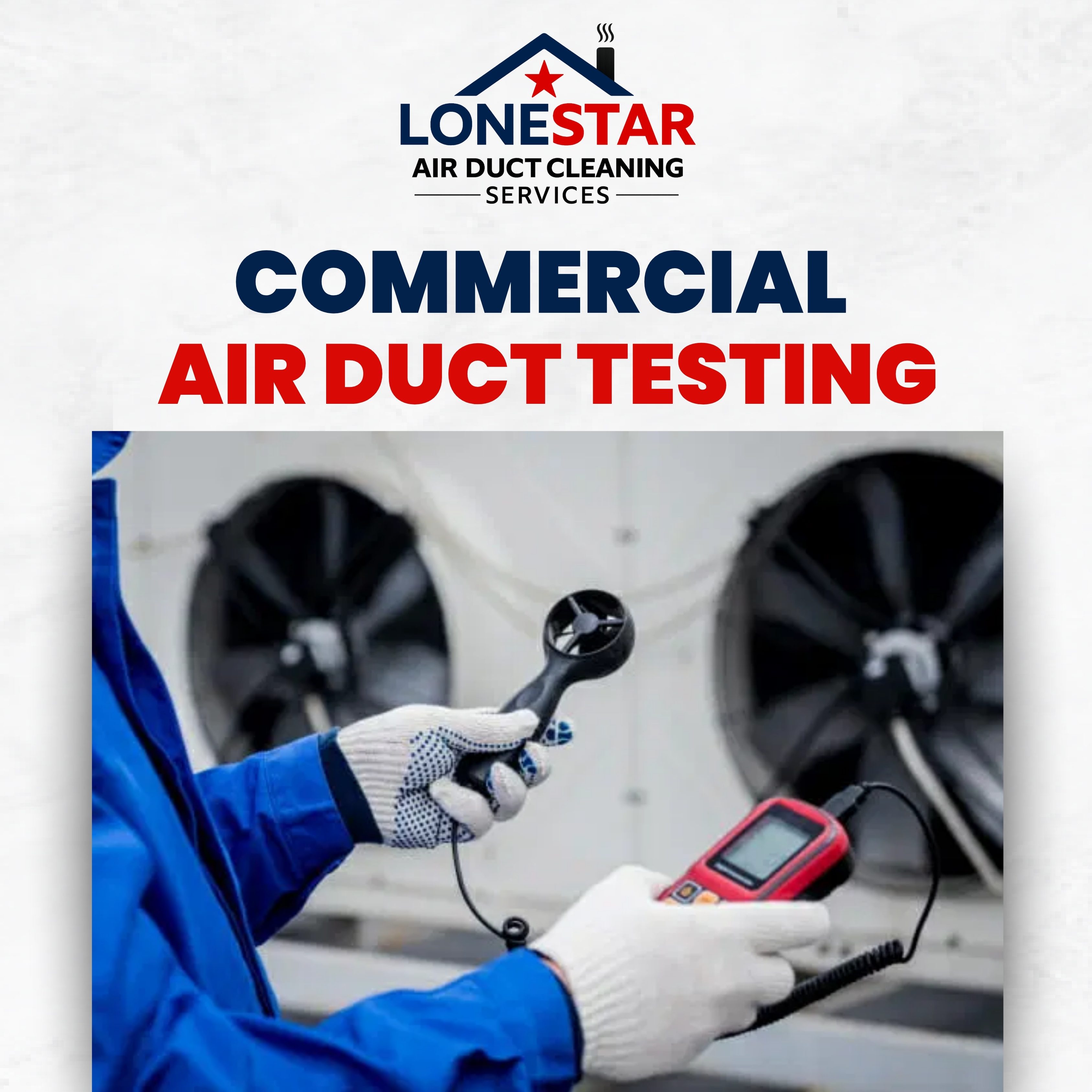
Commercial Air Duct Testing In Seabrook
Book Commercial Air Duct Testing In Seabrook with Lone Star Air Duct Cleaning Services for cleaner air, compliance support, and detailed reporting for facilities
Table of Contents
Commercial Air Duct Testing in Seabrook, Texas
Commercial Air Duct Testing in Seabrook, Texas helps building owners, property managers, and facility teams understand what is happening inside their ductwork. Lone Star Air Duct Cleaning Services checks commercial HVAC duct systems for airflow concerns, debris buildup, visible contamination, odor sources, and signs that the system needs closer attention.
You can expect a practical site visit, clear communication, and written findings that help you plan the next step. We work with offices, restaurants, medical spaces, retail suites, schools, churches, warehouses, and mixed use properties around Seabrook. If testing points to buildup, Commercial Air Duct Cleaning in Seabrook, Texas may be the next service to consider.
Need Help? Call Lone Star Air Duct Cleaning Services near you
What commercial air duct testing means
Commercial air duct testing is a check of the duct system and connected HVAC components. The goal is to gather useful information, not guess from across the room.
A technician may inspect accessible duct sections, vents, returns, air handlers, filters, drain pans, fan compartments, and related areas. Depending on the concern, testing may include airflow readings, visual checks, dust and debris observations, odor tracing, moisture checks, and notes about system condition. For broader service context, you can review Commercial Air Duct Testing.
For a Seabrook business, this can help when staff report a musty smell near a back hallway, or when tenants say one side of the office feels stuffy while another side feels fine. Air duct testing gives everyone something more useful than office folklore.
Who uses commercial air duct testing in Seabrook
Commercial air duct testing is useful for many types of properties along NASA Parkway, State Highway 146, Repsdorph Road, and the areas near Clear Lake and Galveston Bay. Some buildings also need periodic Commercial Air Duct Maintenance in Seabrook, Texas when testing shows conditions that should be watched over time.
- Office building managers
- Restaurant owners
- Retail strip center operators
- Medical and dental office managers
- Daycare and school administrators
- Church facility teams
- Hotel and lodging managers
- Warehouse and light industrial supervisors
- Marina and waterfront business operators
- Property managers handling tenant complaints
Seabrook has waterfront buildings, older commercial suites, newer tenant buildouts, and properties that see salty coastal air. Each building has its own HVAC story. Some are simple. Some have a plot twist.
What to expect during a site visit
A commercial duct testing visit usually starts with a short walkthrough. We ask what has been noticed, where the concern shows up, and when it happens. A facility manager may say the conference room gets stale after lunch, or that the second floor return smells odd after heavy rain. Those details matter because they help point the inspection in the right direction.
- Reviewing the areas of concern
- Looking at supply vents and return grilles
- Checking accessible duct openings
- Inspecting filters and air handler areas
- Looking for dust, moisture, stains, loose connections, or odor clues
- Taking basic readings when needed
- Documenting findings with notes and photos when useful
- Explaining practical next steps
We keep the process clear. No scare tactics. No mystery language. Just plain talk about what we find. If access reveals damaged sections, Commercial Air Duct Repair in Seabrook, Texas may be discussed as a possible follow up.
Need Help? Call us for Air Ducts, Dryer Vents and more!
Why Seabrook buildings need air duct testing
Seabrook sits near Clear Lake, Galveston Bay, Kemah, El Lago, and Taylor Lake Village. That location is great for boat days and seafood lunches, but coastal air can be tough on buildings.
- Humid outdoor air
- Salt air exposure
- Frequent cooling demand
- Pollen from nearby green areas
- Dust from nearby road work or tenant improvements
- Moisture after heavy Gulf Coast rain
- Odors from kitchens, trash rooms, restrooms, or storage areas
- Older ductwork in long used commercial spaces
A building near the Seabrook Marina may have different concerns than a medical office near NASA Parkway. A restaurant near Waterfront Drive may need different checks than a small office near Red Bluff Road. Testing helps sort out what is actually happening.
Problems air duct testing can help identify
Commercial air duct testing can help find clues related to comfort, air movement, odors, dust, and moisture. It is not a magic wand, but it is a useful tool.
- Dust buildup around supply vents
- Debris inside accessible duct sections
- Uneven airflow between rooms
- Blocked or restricted returns
- Dirty filters or filter bypass
- Moisture near coils or drain pans
- Odor sources near returns
- Loose or damaged duct connections
- Signs of pest activity in accessible areas
- Staining that may need more review
- Tenant improvement work that affected airflow
Sometimes the issue is not inside the ducts at all. It may be a clogged filter, a return placed too close to a janitor closet, or a thermostat fighting afternoon sun through a large window. That is why testing matters. It keeps everyone from barking up the wrong tree.
How testing differs from duct cleaning
Testing and cleaning are related, but they are not the same service. Testing checks conditions and gathers information. Cleaning removes debris from the duct system and HVAC components when cleaning is the right step.
| Service | Main purpose | When it helps |
|---|---|---|
| Air duct testing | Checks conditions and documents findings | When there are complaints, odors, airflow issues, or maintenance questions |
| Air duct cleaning | Removes buildup from ductwork and related components | When testing or inspection shows cleaning is needed |
Some buildings need testing first. Some need cleaning after years of use or after construction work. Some need a maintenance adjustment instead. In other cases, aging or heavily affected sections may lead to Commercial Air Duct Replacement in Seabrook, Texas. The right answer depends on what is found.
Areas of a commercial HVAC system that may be checked
The exact access points vary by building. Commercial systems can be simple rooftop units, split systems, variable air volume setups, or larger air handler systems serving multiple zones.
- Supply registers
- Return grilles
- Accessible duct interiors
- Air handler cabinets
- Blower sections
- Filter racks
- Evaporator coil areas when accessible
- Drain pans
- Plenums
- Flex duct runs
- Sheet metal duct sections
- Dampers and zone areas when reachable
- Ceiling cavity conditions near HVAC components
Some areas may be above ceiling tiles. Some may be on the roof. Some may be behind locked mechanical rooms. We coordinate access with your team so the visit can move smoothly. If a buildout needs new duct pathways, Commercial Air Duct Installation in Seabrook, Texas may be part of the conversation.
When a business should schedule testing
You do not need to wait until everyone in the office becomes an amateur HVAC detective. Testing can help when a pattern starts to show.
- Employees report stale or musty air
- Tenants complain about dust near vents
- Rooms have uneven airflow
- Odors appear when the HVAC turns on
- A property has had recent remodeling
- A roof leak or water event affected ceiling areas
- Filters are getting dirty faster than usual
- A new tenant wants a record of HVAC duct condition
- A building has been vacant and is being reopened
- You are planning duct cleaning and want a baseline check
A common Seabrook scenario is a small commercial suite near NASA Parkway that has gone through several tenant changes. Walls move. Ceiling tiles move. Vents get covered. A return path may get blocked. Testing can help spot those changes before they turn into daily complaints.
To plan a visit, use our Contact Us page or call (830) 430-1849. Scheduling ahead helps us coordinate roof access, tenant access, and business hours.
Local conditions that affect Seabrook duct systems
Coastal humidity
Humidity can make minor HVAC issues more noticeable. If air is not moving well, rooms can feel damp or stale. Moisture can also affect ceiling spaces and duct insulation. If insulation concerns are part of the property review, Commercial Attic Insulation in Seabrook, Texas may be relevant.
Salt air
Properties near the bay, marinas, and open water may see more wear on exposed metal components. Roof mounted HVAC equipment can show signs of coastal exposure faster than inland properties.
Storms and heavy rain
After heavy rain, leaks around roofs, curbs, and penetrations may affect ceiling areas near ductwork. Sometimes the duct system gets blamed, but the real issue starts above the ceiling.
High cooling demand
Commercial HVAC systems in Seabrook work hard for much of the year. Long run times can move a lot of air through filters, coils, and ductwork. Regular checks help facility teams stay aware of changing conditions.
Buildouts and renovations
Retail centers and offices often change layout over time. A former open office may become exam rooms. A storage room may become a break room. If ductwork is not updated with the layout, comfort issues can follow.
How testing helps with tenant complaints
Tenant complaints can be tricky because people describe air issues in different ways. Testing gives property managers a better way to respond. Instead of trading opinions, you can review the system, document conditions, and decide what action makes sense.
- It smells old in here
- My office is always warm
- There is dust on my desk every morning
- The vent above reception is noisy
- The back room feels like a closet
In a Seabrook strip center, a restaurant, salon, and insurance office may share similar roof units but have very different indoor needs. Testing can help sort out whether a concern is tied to duct condition, airflow, filtration, odor transfer, or another building issue.
Testing after construction or remodeling
Testing is often useful after tenant improvements, flooring replacement, ceiling work, or wall changes. Construction dust can travel. Ceiling work can disturb old debris. Contractors may move vents or returns. A covered return grille can cause more trouble than people expect.
- Dust inside accessible duct sections
- Registers left disconnected
- Ducts kinked above ceilings
- Vents blocked by new walls or furniture
- Return airflow restrictions
- Filter racks affected by construction debris
- Odors from new materials moving through the air system
A manager may point to a vent and say it has been weak since a wall moved. The wall may be the clue. The duct system is not being dramatic. It may be trying to breathe through a bad layout.
Testing for odor concerns
Odors are a common reason businesses call for commercial air duct testing in Seabrook. Testing can help trace where the odor is strongest and whether the HVAC system is spreading it. Sometimes the ductwork is the source. Sometimes it is the messenger.
- Moisture near HVAC equipment
- Dirty filters
- Dust inside returns
- Restroom exhaust issues
- Kitchen air movement
- Trash storage areas
- Chemicals stored near returns
- Plumbing traps
- Outdoor air intake locations
- Pest activity
- Ceiling space contamination
A café near the water may have food odors moving into an office hallway. A medical suite may notice a musty smell after weekend shutdowns. A retail tenant may smell cleaning chemicals because supplies are stored next to a return grille. Little things can make a big stink.

Testing for dust complaints
Dust near vents may come from duct buildup, filter bypass, poor housekeeping paths, ceiling tile debris, outdoor air entry, or construction activity. During testing, we may look at dust patterns around supply registers, filter condition and fit, return grille buildup, accessible duct interiors, ceiling cavity dust near openings, and recent work that may have disturbed debris.
A retail shop near Highway 146 may see more dust during nearby road work. A warehouse office may pull in dust from shop space if pressure and return paths are off. A daycare may notice dust faster because surfaces are wiped often and staff pay close attention. Testing helps separate normal dust from something that needs follow up.
Testing for airflow problems
Airflow problems can make a building uncomfortable fast. In a commercial setting, uneven airflow can affect employees, customers, equipment rooms, and tenant satisfaction.
- Hot or cold rooms
- Weak air at certain vents
- Noisy vents
- Doors that are hard to open or that slam
- Rooms that feel stuffy
- Short cycling HVAC equipment
- Pressure differences between spaces
Testing may include checking airflow at vents, looking for closed dampers, checking filters, and reviewing accessible duct runs. A conference room near a sunny window wall may need more than a vent check. A back office built inside a former storage area may not have enough supply or return air.
What affects results and timing
Several things can affect what can be tested, how long it takes, and what the findings show.
- Building size
- Number of HVAC units
- Roof access
- Ceiling height
- Locked mechanical rooms
- Active business hours
- Tenant access limits
- Recent cleaning or construction
- Weather conditions
- System type and age
- How much ductwork is accessible
- Whether equipment is running normally
Timing may also depend on how many areas need review. A single tenant suite is different from a multi building commercial property near the waterfront. Weather can matter too. A heavy rain day may change odor patterns. A hot afternoon may make airflow complaints easier to observe.
Information to share before the visit
The more useful the background, the better the site visit can be planned. You do not need a technical report before calling. Simple details help.
- Business type
- Building size
- Number of floors
- Number of HVAC units if known
- Areas with complaints
- When the issue started
- Recent roof leaks or water events
- Recent remodeling or ceiling work
- Filter change history
- Odors, dust, or airflow concerns
- Access limits or tenant schedules
If you are not sure about the HVAC system type, that is fine. Many property managers inherit buildings with mystery units and faded labels. We have seen plenty of situations where nobody is fully sure which unit feeds which side.
How to prepare for air duct testing
A little preparation helps the visit go more smoothly. If the building is open to customers, we can talk through how to reduce disruption. Some checks are quick. Others need ceiling tile access or unit access.
- Make sure mechanical rooms can be accessed
- Arrange roof access if needed
- Let tenants know which areas may be checked
- Move furniture away from key vents when possible
- Share any known safety rules for the site
- Provide contact information for the person on site
- Have recent HVAC service notes ready if available
- Point out any areas with odors, dust, or comfort complaints
We will explain what we need before we start checking the system. That helps your staff, tenants, and customers know what to expect.
What happens after testing
After the site visit, Lone Star Air Duct Cleaning Services explains the findings in plain language. The goal is to help you decide what action makes sense for the property.
- No immediate duct work
- Filter fit correction
- Duct cleaning
- Dryer vent cleaning for laundry areas
- HVAC service by your mechanical contractor
- Further review of moisture sources
- Adjustments to vents, returns, or dampers
- Follow up after repairs or remodeling
We may also provide photos or notes from the areas reviewed. This helps managers discuss the issue with owners, tenants, maintenance staff, or HVAC service teams. For laundry areas that need better vent movement, Commercial Dryer Vent Booster Fan Installation in Seabrook, Texas may also be useful.
Does every building need duct cleaning after testing
No. Testing does not always lead to duct cleaning. Sometimes the ductwork looks acceptable, but the filter rack has a gap. Sometimes the ducts are not the issue, but a drain pan or roof leak is. Sometimes airflow is weak because a damper is closed or a flex duct is kinked.
Cleaning may be a sensible next step when there is visible debris, buildup, or conditions that point toward cleaning. Testing helps avoid guesswork. Nobody wants to spend time chasing the wrong rabbit. A clear inspection helps keep the plan grounded.
How often commercial ducts should be tested
There is no single schedule that fits every Seabrook property. Testing frequency depends on building use, occupant needs, maintenance history, and local conditions.
- After a tenant change
- After remodeling
- After water damage
- When complaints start
- Before planned duct cleaning
- During property turnover
- When reopening a vacant space
- As part of a facility maintenance review
A busy restaurant may need more frequent checks than a small office. A medical office may keep tighter maintenance records than a warehouse office. A waterfront property may deal with more moisture concerns than a building farther inland.
Types of Seabrook properties we visit
Lone Star Air Duct Cleaning Services works with many commercial property types in and near Seabrook. To learn more about the company and team, visit our About Us page.
- Office suites near NASA Parkway
- Restaurants close to Kemah and the waterfront
- Retail shops near Highway 146
- Medical offices serving Seabrook and Clear Lake
- Churches near residential neighborhoods
- Schools and childcare facilities
- Boat related businesses near marinas
- Small warehouses and service shops
- Mixed use buildings
- Multi tenant commercial centers
We also understand that Seabrook has homes near commercial corridors. Some property owners manage both residential rentals and small business spaces. If you have a commercial system or a mixed use setup, we can discuss the right service approach.
Nearby neighborhoods and landmarks
Seabrook has a strong local identity. Many service calls come from areas near Clear Lake, Taylor Lake, Galveston Bay, and the roads that connect Seabrook to Kemah, League City, Pasadena, and La Porte.
- Seabrook Marina
- Pine Gully Park
- Robinson Park
- Clear Lake Park
- NASA Parkway
- State Highway 146
- Repsdorph Road
- Red Bluff Road
- Todville Road
- El Jardin
- Taylor Lake Village
- El Lago
- Kemah Boardwalk area
- Clear Lake Shores
These local settings matter because building use and weather exposure vary across town. A waterfront restaurant, a marina office, and an inland office suite may all need different observations during testing. You can also review our Seabrook, Texas service areas page.
Common ZIP codes around Seabrook
For commercial air duct testing in Seabrook, service commonly covers properties in and near these local ZIP codes.
77586, 77565, 77058, 77573, 77507, 77571, 77518, 77539
These ZIP codes include Seabrook and nearby communities around Clear Lake, Kemah, League City, Pasadena, La Porte, Bacliff, and Dickinson. If your property sits near the Seabrook area, call and we can discuss the location. You may also browse our broader Service areas.
Why work with Lone Star Air Duct Cleaning Services
Lone Star Air Duct Cleaning Services focuses on air duct and dryer vent cleaning services for Texas properties. For commercial air duct testing, we aim to give facility teams useful findings without overcomplicating the process.
- Clear scheduling communication
- Respect for your business hours
- Practical inspection notes
- Plain language explanations
- Care around customers, staff, and tenants
- Attention to local Seabrook conditions
- A focus on what the building actually shows
We know commercial spaces can be busy. A restaurant has prep work. A medical office has patients. A retail shop has customers walking in. We plan visits with that real world activity in mind.
Related services in Seabrook, Texas
- Commercial Air Duct Cleaning in Seabrook, Texas
- Commercial Air Duct Installation in Seabrook, Texas
- Commercial Air Duct Maintenance in Seabrook, Texas
- Commercial Air Duct Repair in Seabrook, Texas
- Commercial Air Duct Replacement in Seabrook, Texas
- Commercial Attic Insulation in Seabrook, Texas
- Commercial Dryer Vent Booster Fan Installation in Seabrook, Texas
- Commercial Air Duct Testing
- Commercial Air Duct Cleaning
- Commercial Air Duct Installation
- Commercial Air Duct Maintenance
- Commercial Air Duct Repair
Schedule commercial air duct testing in Seabrook
If your Seabrook building has dust concerns, odor complaints, uneven airflow, or questions after remodeling, Lone Star Air Duct Cleaning Services can help you take a closer look.
Call (830) 430-1849 to schedule commercial air duct testing in Seabrook. You can also visit the Lone Star Air Duct Cleaning Services website to learn more about our air duct and dryer vent services.
Frequently Asked Questions (FAQs)
Commercial air duct testing is an evaluation of ductwork and related HVAC airflow/condition indicators to help identify potential issues like leakage, dust buildup, or ventilation imbalances. Many Seabrook businesses use it to support indoor air quality and HVAC performance planning.
Offices, retail spaces, restaurants, medical facilities, warehouses, and multi-tenant properties commonly request testing, especially when occupancy, layouts, or HVAC usage patterns change.
Testing is often considered after renovations, when moving into a new space, during routine HVAC maintenance cycles, or if there are ongoing comfort complaints like uneven temperatures or persistent dust concerns.
It can help flag potential airflow restrictions, duct leakage concerns, ventilation balance problems, and conditions that may contribute to odors or dust distribution—guiding next steps for maintenance or cleaning.
No. Testing focuses on assessing duct system conditions and performance indicators, while cleaning focuses on removing accumulated debris. Lone Star Air Duct Cleaning Services offers a range of services, including Commercial Air Duct Testing and duct cleaning, depending on what a site needs.
It’s typically planned to minimize disruption, often coordinated around business hours, access needs, and safety requirements. The exact workflow depends on the building layout and HVAC setup.
Common preparation includes ensuring access to mechanical rooms, ceiling/duct access points, and relevant HVAC areas, and sharing any known comfort or air quality concerns so the evaluation can focus on priority areas.
It can help identify ventilation or airflow factors that may contribute to odor or stale-air complaints. Results are often used to decide whether maintenance, filtration changes, duct cleaning, or HVAC adjustments should be considered.
There isn’t a single schedule that fits every property. Many businesses base timing on building use, occupancy, HVAC runtime, maintenance history, and any recurring comfort or air quality concerns.
Lone Star Air Duct Cleaning Services offers a range of services that can support commercial HVAC upkeep, including Commercial Air Duct Testing, along with related duct and ventilation-focused services depending on the building’s needs.
What Is Duct Leakage Testing, and When Is It Worth Scheduling?
Duct leakage testing measures how much heated or cooled air escapes from ductwork. It can…
Air Duct Repair vs Replacement for Aging Ductwork
Compare air duct repair and replacement by looking at the damage, leakage, insulation, moisture, airflow,…
Why Does My House Get Dusty Right After I Clean? Duct Questions to Consider
Dust that returns fast may come from filter gaps, leaks, recent work, or duct debris.…