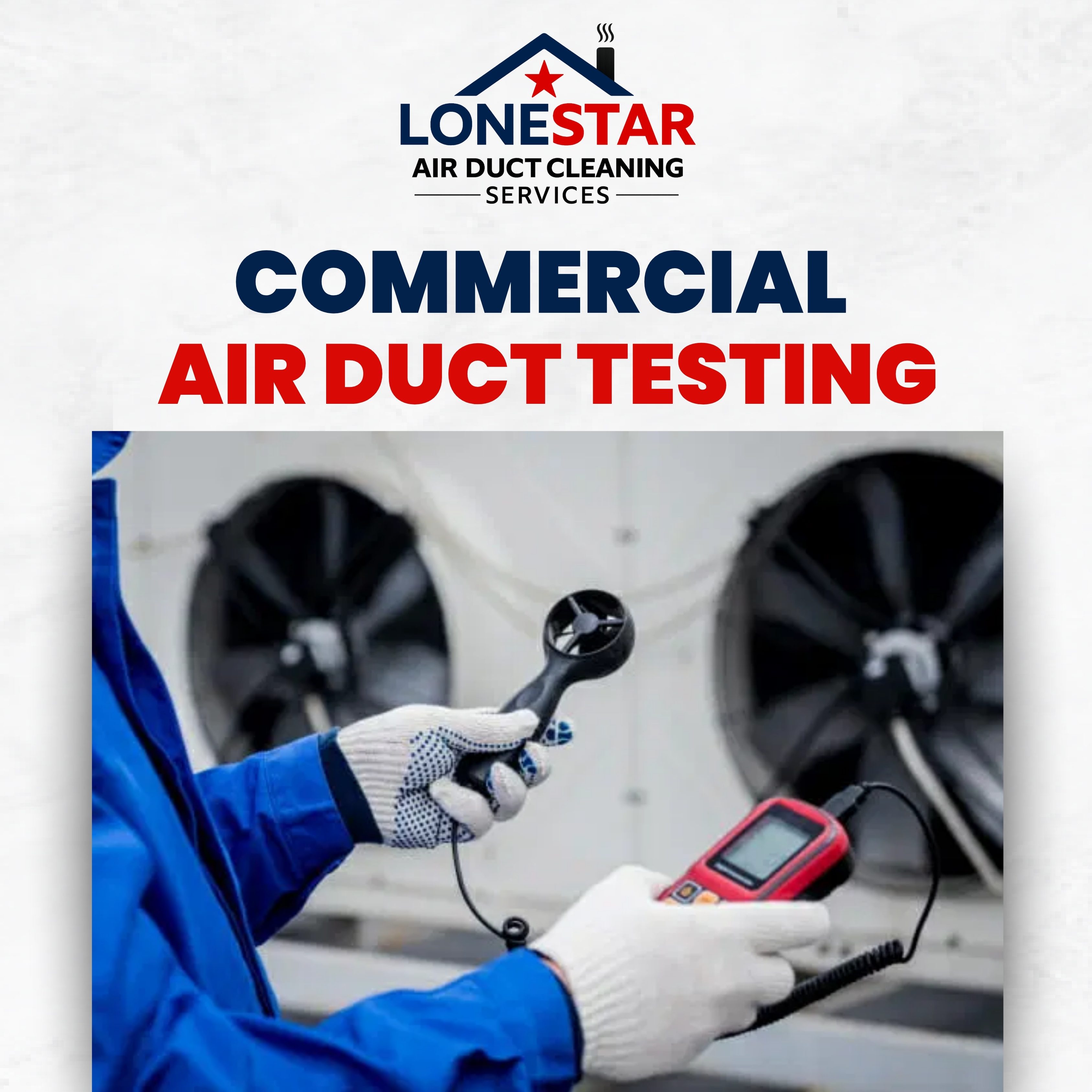
Commercial Air Duct Testing In La Porte
Get Commercial Air Duct Testing In La Porte from Lone Star Air Duct Cleaning Services for cleaner airflow, reports, and compliance support for your facility
Table of Contents
Commercial Air Duct Testing in La Porte, Texas
Commercial Air Duct Testing in La Porte, Texas helps local facilities check duct condition, airflow, cleanliness, and performance concerns inside a commercial duct system. It gives property managers, facility teams, building owners, tenants, schools, clinics, restaurants, warehouses, offices, and retail spaces a clearer look at what may be happening behind the vents.
When Lone Star Air Duct Cleaning Services visits your La Porte facility, you can expect a practical inspection, testing where access allows, clear notes, and a plain-language report. The visit may look for airflow problems, debris buildup, moisture concerns, damaged duct sections, odor sources, and signs that the system may need Commercial Air Duct Cleaning in La Porte, Texas or Commercial Air Duct Repair in La Porte, Texas.
Need Help? Call Lone Star Air Duct Cleaning Services near you
What commercial air duct testing includes
Commercial duct testing is not a quick glance at a vent. It is a structured check of the duct system and the areas that affect airflow. A typical visit may include visual inspection of supply and return vents, airflow checks at selected registers, duct access review, interior duct condition checks where access is available, dust and debris observations, moisture and staining checks, odor source review, photos of useful findings, and practical next steps for cleaning, repair review, or Commercial Air Duct Maintenance in La Porte, Texas.
- Visual inspection of selected supply and return vents
- Airflow checks at selected registers
- Duct access review
- Interior duct condition checks where access is available
- Dust and debris observations
- Moisture and staining checks
- Odor source review
- Photo notes when useful
- Notes on damaged, loose, or disconnected sections
- Practical next steps for service planning
Every building is different. A small office near Fairmont Parkway may need a different approach than a warehouse close to Highway 146 or a restaurant near Main Street. The goal is to gather useful information without making the process harder than it needs to be.
Who needs commercial duct testing in La Porte
Duct testing is useful for many types of commercial properties. If your building has staff, customers, tenants, equipment, or inventory relying on conditioned air, testing can help you make better maintenance choices. Local facilities can also review La Porte, Texas service areas when confirming coverage for nearby commercial corridors.
- Office buildings
- Medical and dental offices
- Retail shops
- Restaurants and cafes
- Warehouses
- Light industrial buildings
- Schools and daycare spaces
- Churches and community buildings
- Gyms and fitness rooms
- Apartment leasing offices and common areas
- Hotels and lodging properties
- Auto shops and service centers
La Porte has a mix of coastal, industrial, retail, and neighborhood properties. A shop near Spencer Highway may deal with dust from traffic and frequent door openings. A building closer to Galveston Bay may see more humidity concerns. A facility near Barbours Cut or the port area may have heavy use patterns and more outdoor particulates entering the building.
Why La Porte businesses request duct testing
Many calls start with one simple concern. One room feels different, one area smells musty, or one office seems dusty right after cleaning. Testing helps replace guesswork with clear observations. If the inspection points to damaged ductwork, Commercial Air Duct Repair in La Porte, Texas may be part of the next conversation. If the system has reached the end of its useful condition, Commercial Air Duct Replacement in La Porte, Texas may need review.
- Uneven airflow between rooms
- Dust returning soon after cleaning
- Musty smells near vents
- Hot and cold spots
- Recent remodeling work
- Concerns after roof leaks or storm activity
- Complaints from employees or tenants
- HVAC system changes
- Dirty ceiling tiles around vents
- Visible debris inside registers
- A need for documentation before planning service
Testing is also helpful after a long gap in duct maintenance. Commercial properties change owners, tenants, and managers over time. Records get lost. Someone inherits a building and nobody knows when the ducts were last checked. That is when testing can be a useful first step.
Need Help? Call us for Air Ducts, Dryer Vents and more!
Signs that may point to duct concerns
Commercial duct problems do not always show up loudly. Sometimes they appear as dust trails around vents, black or gray marks on ceiling tiles, weak airflow at certain registers, rooms that never feel comfortable, rattling from ducts, odors when the HVAC starts, damp smells after rain, or debris visible behind vent covers.
A single symptom does not always point to one cause. A musty smell could come from duct moisture, a clogged drain pan, a ceiling leak, stored materials, or a nearby mechanical room. Testing helps narrow the field before work is planned. In some buildings, the next step may involve Commercial Air Duct Cleaning in La Porte, Texas. In others, the concern may be building use, access, filtration, or maintenance related.
How local weather affects testing
La Porte sits close to Galveston Bay and the Houston Ship Channel area. Warm air, humidity, salt air, and storm seasons all play a part in how commercial buildings behave. Buildings near Sylvan Beach, Shoreacres, and Morgan’s Point can see more humidity concerns than some inland properties. Spaces near Highway 146 and Fairmont Parkway may have more traffic dust entering through doors, loading bays, and older building gaps.
Testing does not treat every building the same. A gym, a seafood restaurant, and a machine shop all have different air concerns. Some buildings also have attic or upper ceiling areas that affect comfort, which can make Commercial Attic Insulation in La Porte, Texas worth reviewing when the concern involves heat gain or uneven comfort.
What happens during a testing visit
A testing visit is usually direct and orderly. The technician works with your point of contact to understand the concern, layout, access rules, and complaint areas. The process may include a walkthrough, vent and return review, access check, airflow observations, interior condition review where access allows, photo notes, a summary discussion, and report support.
| Step | What it helps clarify |
|---|---|
| Walkthrough | Main concerns, complaint areas, recent work, and access needs |
| Vent review | Dirt, staining, damage, airflow concerns, and visible debris |
| Access check | Safe places to view duct interiors where possible |
| Summary | Plain-language findings and practical next steps |
Commercial systems can hide a lot. A ceiling tile comes down, someone sees a duct condition that does not look right, and now the whole team wants answers. Testing helps the building team move from guesses to documented observations.
Areas of the building that may be checked
Commercial duct systems connect many parts of a building. Testing may focus on the whole system or on certain rooms where problems are being reported. Areas often checked include lobby supply vents, office vents, conference rooms, restrooms, break rooms, storage rooms, return air grilles, ceiling plenums where present, mechanical rooms, rooftop unit connections, duct transitions, areas near past leaks, and areas near renovation work.
In La Porte, issues often show up in front office areas connected to warehouses. The warehouse doors open all day, outdoor air moves in, dust follows, and the office staff wonders why desks get dusty again by midweek. Testing helps show whether the issue is duct related, building use related, or a mix of both. If airflow changes are tied to altered layouts, Commercial Air Duct Installation in La Porte, Texas may need review.
Testing before cleaning or other service
Testing can help decide whether duct cleaning is needed, which areas need the most attention, and whether other concerns should be reviewed first. It may be helpful when the duct history is unknown, the building has changed tenants, remodeling was recently completed, employees have reported dust or odor issues, a manager needs documentation, or a large system needs phased planning.
Not every dusty room means the entire duct system needs the same service. Some issues start at return grilles. Some come from ceiling cavities. Some come from open doors, storage rooms, or filter problems. Testing helps avoid guessing. If cleaning is recommended, the findings can support a clearer scope for Commercial Air Duct Cleaning or local cleaning service in La Porte.
Testing after cleaning, repairs, or build-outs
Duct testing can also be useful after cleaning, HVAC work, building repairs, tenant build-outs, roof leak repairs, ceiling tile replacement, construction dust cleanup, air balance work, and return air changes. It gives the facility team a record of current conditions and can point out remaining concerns.
A common La Porte scenario is a tenant finish-out in a strip center. Walls move, ceiling work happens, vents get relocated, and construction dust ends up where it should not. Testing after the work can help the property team see what conditions look like before regular business activity begins. If the work involved altered duct runs, Commercial Air Duct Installation or Commercial Air Duct Replacement may be part of planning.
Factors that can affect results and timing
Commercial testing can be affected by building layout, weather, access, system age, and how the space is used. Some buildings are simple. Others have ductwork tucked behind hard ceilings, locked roof access, or mechanical rooms that need extra coordination.
- Number of HVAC units
- Size of the building
- Ceiling height
- Type of duct material
- Access to ducts and rooftop units
- Occupied work areas
- Safety rules for industrial sites
- Recent cleaning or construction
- Filter condition
- Outdoor humidity
- Rain or wind before the visit
- Past leaks or water staining
- Tenant schedules
- After-hours access needs
A small retail space near Five Points may be tested faster than a large warehouse near the port corridor. A medical office may need more care around occupied rooms. A school or daycare may need testing planned around class schedules.
Problems testing may uncover
Commercial duct testing may identify heavy dust inside ducts, debris from construction, loose insulation, moisture staining, rust on metal duct sections, disconnected or crushed duct runs, dirty return areas, poor airflow at selected vents, blocked registers, ceiling tile staining near vents, odors linked to return pathways, evidence of past water entry, duct access limitations, damaged vent covers, or gaps where air may be pulled from dirty spaces.
The report does not need fancy language to be useful. If a return is pulling air from a dusty storage closet, you need to know that. If a duct above a conference room has debris from a renovation, you need to know that too. If a separate venting concern is found in a commercial laundry area, Commercial Dryer Vent Booster Fan Installation in La Porte, Texas may be a related service to consider.
How commercial testing differs from residential testing
Commercial duct testing is usually more involved than residential testing because the systems are larger and the buildings have more variables. Commercial buildings may have multiple HVAC units, rooftop package units, long duct runs, shared tenant spaces, ceiling plenums, more return air pathways, higher occupancy, loading areas, special use rooms, building access rules, maintenance logs, tenant concerns, and more complex schedules.
Residential testing often focuses on comfort, dust, and possible duct leakage in a home. Commercial testing may also support facility records, tenant communication, work planning, and internal maintenance review. La Porte has residential and commercial pockets close together, so testing should match the building instead of using a one-size-fits-all checklist.
How to prepare before the visit
A little preparation helps the visit move smoothly. Before the appointment, it helps to gather the building layout if available, HVAC unit locations, roof access details, mechanical room access, known complaint areas, filter change records if handy, recent repair notes, remodel or construction history, water leak history, tenant schedule limits, safety rules for the site, and a contact person for the visit.
You do not need everything perfect. If you have notes on the main concern, that is a solid start. Even a simple comment about a back office smelling musty after rain can guide the inspection. For broader coverage questions, the Service areas page can help confirm nearby communities.

What the report may include
After testing, Lone Star Air Duct Cleaning Services provides clear information you can use. The report format can vary by building and scope, but the goal stays the same. Findings should be easy to understand and useful for maintenance planning.
- Areas checked
- Photos of notable findings
- Notes on visible duct condition
- Airflow observations
- Dust and debris observations
- Moisture or staining concerns
- Access limitations
- Areas that may need cleaning
- Areas that may need repair review
- Practical next steps
Reports can help with internal maintenance planning, tenant updates, or compliance support. They can also help owners compare conditions across multiple buildings in the La Porte area.
Common La Porte duct concerns
Certain building types and local areas tend to bring up repeat issues. Restaurants near Main Street may deal with odors and grease-adjacent dust. Retail spaces along Fairmont Parkway may have frequent door traffic. Warehouses near Highway 146 may have loading doors opening often. Offices close to Spencer Highway may have traffic dust and older duct layouts. Properties near Sylvan Beach may see humidity-related concerns.
A duct system does not live in a bubble. The building, the weather, the people, and the work inside all affect what testing may find. Where maintenance needs are ongoing, Commercial Air Duct Maintenance can help support planning after the initial testing notes are reviewed.
Scheduling and company information
Most testing visits can be planned to reduce disruption. A restaurant may prefer testing between meal rushes. A clinic may need certain rooms left alone while patients are present. A warehouse may need testing planned around deliveries. To discuss access, timing, and the concern at your building, use the Contact Us page.
Lone Star Air Duct Cleaning Services is based in Houston, TX and serves La Porte with a practical approach to commercial duct and vent concerns. Businesses can learn more about the company and team on the About Us page.
Related services in La Porte, Texas
- Commercial Air Duct Cleaning in La Porte, Texas
- Commercial Air Duct Installation in La Porte, Texas
- Commercial Air Duct Maintenance in La Porte, Texas
- Commercial Air Duct Repair in La Porte, Texas
- Commercial Air Duct Replacement in La Porte, Texas
- Commercial Attic Insulation in La Porte, Texas
- Commercial Dryer Vent Booster Fan Installation in La Porte, Texas
- Commercial Air Duct Testing
- Commercial Air Duct Cleaning
- Commercial Air Duct Installation
- Commercial Air Duct Maintenance
- Commercial Air Duct Repair
- Commercial Air Duct Replacement
- Commercial Attic Insulation
Schedule commercial air duct testing in La Porte
If your La Porte facility has dust concerns, odor complaints, airflow issues, or unknown duct conditions, Lone Star Air Duct Cleaning Services can help you get clear information before you plan the next step. Call (830) 430-1849 to discuss commercial duct testing for your building.
Frequently Asked Questions (FAQs)
Commercial air duct testing is an evaluation of airflow and duct conditions to help identify potential issues like leaks, restrictions, or buildup. Local businesses often request it to better understand indoor air movement and support maintenance planning.
Common reasons include inconsistent temperatures, rooms that feel stuffy, noticeable dust, or concerns after renovations or tenant changes. A general assessment can help determine whether testing makes sense.
Testing is often planned to reduce disruption, such as scheduling around business hours or working in phases. The exact impact depends on the building layout and access to ductwork.
Many property types can consider testing, including offices, retail spaces, warehouses, medical facilities, restaurants, and multi-tenant buildings, especially when HVAC performance questions come up.
It generally includes a review of the HVAC setup, basic measurements or observations related to airflow and duct condition, and a summary of findings to guide next steps.
No. Testing focuses on evaluating system performance and duct conditions, while cleaning focuses on removing accumulated debris from ductwork and related components.
Testing can provide information about airflow patterns and duct conditions that may contribute to comfort or air quality concerns, which can support decisions about maintenance or additional services.
Frequency varies by building use, HVAC workload, and changes like remodels or occupancy shifts. Many businesses consider it when issues arise or as part of periodic HVAC planning.
Yes. Lone Star Air Duct Cleaning Services offers a range of services, including Commercial Air Duct Testing, along with other air-duct and HVAC-related support options.
It helps to provide access to mechanical rooms, ceiling panels or vents where applicable, and any recent HVAC service notes. Coordinating a point of contact on-site can also streamline the visit.
What Is Duct Leakage Testing, and When Is It Worth Scheduling?
Duct leakage testing measures how much heated or cooled air escapes from ductwork. It can…
Air Duct Repair vs Replacement for Aging Ductwork
Compare air duct repair and replacement by looking at the damage, leakage, insulation, moisture, airflow,…
Why Does My House Get Dusty Right After I Clean? Duct Questions to Consider
Dust that returns fast may come from filter gaps, leaks, recent work, or duct debris.…